Struggling to Grow Your Business Online? Here's What's Actually Missing
02 May, 2026 12:55 PM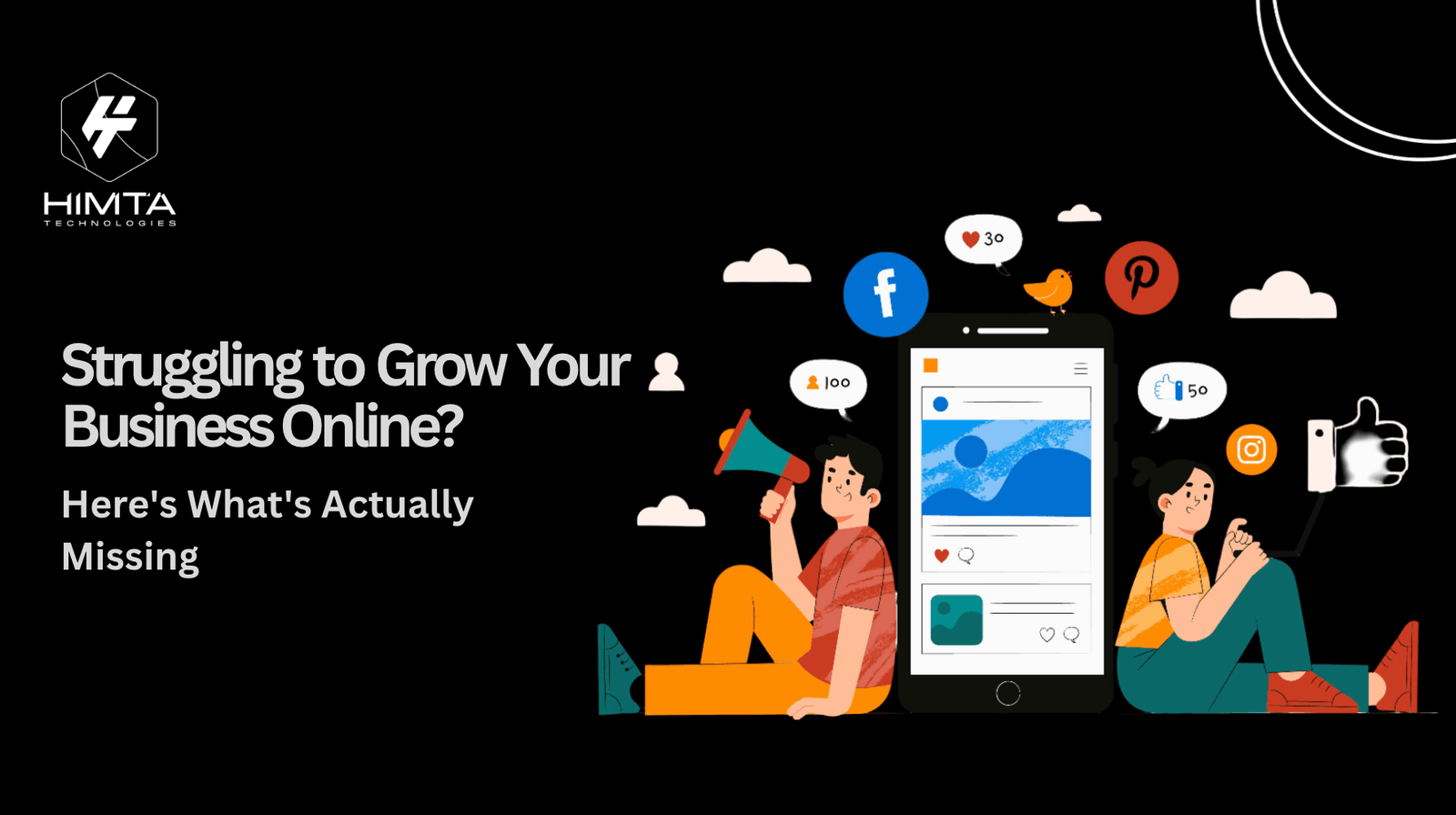
Let's be honest — most businesses in Ahmedabad aren't failing because the product is bad or the team isn't working hard enough. They're struggling because nobody can find them. Or worse, people find them but don't stick around long enough to become customers.
That's a marketing problem. And it's more common than most business owners like to admit.
The city has changed a lot in the last few years. Every industry — real estate, healthcare, manufacturing, education, retail — is packed with competitors who are all online, all running ads, all fighting for the same eyeballs. Just having a website and posting on Instagram twice a week isn't going to cut it anymore. It hasn't for a while, honestly.
The Scattered Approach Is Costing You More Than You Think
Here's what happens in most growing businesses. Someone in the team handles social media. A freelancer was hired six months ago to "do SEO." The owner occasionally boosts a Facebook post. There's a website, but it was built three years ago and nobody really remembers who manages it.
Sound familiar?
This kind of scattered setup creates the illusion of marketing without the results. Customers today don't buy the first time they see you. They Google your business name, read a few pages, check reviews, scroll your Instagram, maybe visit your site twice, and then decide. If any one of those touchpoints falls flat — a slow website, an empty profile, a confusing landing page — you've lost them.
What actually works is having all of those pieces connected and working toward the same goal. That's not something a part-time effort or a couple of freelancers can really pull off consistently. It needs structure.
Why Most In-House Teams Hit a Wall
There's nothing wrong with starting in-house. For a small business, it makes complete sense. But there's a ceiling to what an internal team can realistically manage, especially when the business is actively trying to grow.
Think about what proper digital marketing actually involves — search visibility, paid campaigns, content creation, landing page design, email sequences, local SEO, performance tracking, audience segmentation, conversion optimization. That's not one job. That's six or seven jobs. And each one has its own learning curve, its own tools, and its own set of best practices that keep changing.
Most businesses can't afford to hire six specialists. And even if they could, managing that team while also running the business is its own challenge.
That's where an agency earns its keep. You get a full team — strategists, writers, designers, ad managers, analysts — without the hiring headaches. And because they work across multiple industries and campaigns, they've already made the mistakes you'd otherwise make yourself.
What a Good Agency Actually Does For You
People sometimes think of agencies as vendors — you give them a brief, they deliver content or ads, done. The best ones don't work that way.
A good agency starts by figuring out where your growth is actually stuck. Is the problem that not enough people know you exist? Is it that people visit your website but leave without doing anything? Are you getting leads but they're the wrong kind? Each of these is a different problem requiring a different solution.
Once that's clear, the work becomes focused rather than generic. You're not just running ads to run ads. You're fixing a specific leak in a specific part of the funnel. That's the difference between marketing that costs money and marketing that makes money.
Being Local Matters More Than Most People Realize
This is something a lot of national agencies miss entirely. Ahmedabad isn't just "a city in India" when it comes to marketing — it has its own rhythms, its own buyer behavior, its own competitive dynamics.
Someone looking for office space near Prahlad Nagar isn't searching the same way or responding to the same messaging as someone looking for a clinic in Naranpura. A textile manufacturer in GIDC has completely different digital needs than a D2C brand targeting young buyers in the city. Even the language preference — Gujarati, Hindi, English — can affect how well a campaign performs.
A team that actually knows this market builds campaigns that fit it. They know which platforms Ahmedabad audiences actually use, how buyers here tend to research before they purchase, what kind of social proof lands, and what kind of messaging feels off. That local instinct is genuinely hard to replicate from a Delhi or Mumbai office.
Search Is Still Where the Best Leads Come From
A lot of businesses chase social media because it's visible and feels active. But if you're looking for buyers with real intent — people who are already looking for what you offer — search is still where that happens.
When someone types "chartered accountant in Ahmedabad" or "office furniture supplier near me" or "best dermatologist in Satellite," they're not browsing. They're ready to act. The business that shows up first, looks credible, and makes it easy to get in touch usually gets the call.
Building that kind of search presence takes time and consistency. It's not a quick win. But over time, it becomes one of the most cost-effective lead sources a business can have — because you're meeting buyers exactly when they're looking, rather than interrupting them when they're not.
Paid Ads Can Work — But They Fail Without the Right Setup
Almost every business has tried running ads at some point. And a lot of them have come away thinking it doesn't work, or that it's too expensive for the return it gives.
Usually, the ads weren't the problem. The setup was.
Targeting the wrong audience. Sending clicks to a homepage instead of a relevant landing page. No real way to track which leads came from which campaign. Optimizing for clicks instead of actual conversions. These are incredibly common mistakes, and they make perfectly good ad budgets feel like they've disappeared into a black hole.
When paid campaigns are set up properly — with clear audience targeting, well-matched landing pages, and tracking that goes beyond surface metrics — they can become the fastest and most scalable way to grow. But that setup requires real expertise and ongoing attention. It's not something you set up once and forget.
Content Does the Selling Before You Even Enter the Room
Somewhere between discovering a business and actually reaching out, most buyers spend time reading. They want to understand what you do, how you work, whether you've handled situations like theirs before, and whether you seem like people worth trusting.
Content is what fills that space. Not fluffy blog posts no one asked for — but genuinely useful, clearly written pages that answer real questions. Service pages that explain your offer without jargon. Case studies or testimonials that show what working with you actually looks like. Articles that help potential customers understand their own problems better.
When that content is good, it does a lot of the trust-building before a prospect ever speaks to your sales team. The conversations that follow are shorter, warmer, and more likely to convert. That's not a small thing.
The Numbers Only Help If Someone Is Actually Reading Them
Here's something that doesn't come up enough — most businesses that invest in digital marketing are swimming in data they don't know what to do with. Google Analytics is installed. Ad reports come in every month. A dashboard somewhere shows a lot of green arrows.
But the real questions go unanswered: Which campaigns are actually bringing in paying customers? Where are leads dropping off? Which audience converts the best? Is the spend going to the right places?
A good agency doesn't just send you a report. It tells you what the report means and what to do differently because of it. That's how marketing gets smarter over time instead of just louder.
We are At Himta Technologies
Himta Technologies works with businesses across Ahmedabad that are serious about growing online — not just being online. The focus is practical: better visibility, better leads, stronger local presence, and marketing that actually connects to revenue.
The approach isn't about applying the same template to every client. It starts with understanding where a business is stuck and building a strategy around solving that specific problem. Search, paid media, content, local SEO, conversion optimization — these aren't separate services. They're pieces of the same system, and they work best when they're built together.
If your current marketing feels like it's doing a lot without moving the needle, that's worth paying attention to. The gap between activity and results is usually where the real work needs to happen.
Frequently Asked Questions
Why does it matter that the agency is based in Ahmedabad?
Because local market knowledge changes how campaigns are built. Buyer behavior, language preferences, platform habits, and competitive dynamics in Ahmedabad are specific enough that a team with genuine experience here will build significantly more effective campaigns than one working from a generic playbook.
How does an agency actually generate more leads?
By improving where you show up (search, maps, ads), making your website and landing pages easier to convert, and targeting the right audience with the right message at the right time. It's usually not one thing — it's several things working together that creates a consistent lead flow.
What should a good digital marketing agency in Ahmedabad offer?
At minimum: search visibility, paid advertising, content, local SEO, and performance tracking. More importantly, they should connect those services into a coherent strategy rather than treating each one as a separate project with no relationship to the others.
Is working with an agency better than hiring in-house?
For most businesses in a growth phase, yes. You get access to specialists across every area of digital marketing without the cost or complexity of building a full team internally. It's also faster — an agency can move quickly because the processes and tools are already in place.
How do you evaluate whether an agency is actually worth it?
Look past the pitch. Ask how they measure success, what reporting looks like, and how they've helped businesses similar to yours. The right agency will talk about your revenue goals before it talks about its own services.
How do I get started with Himta Technologies?
Reach out directly through the website. The first step is usually a conversation about where your business is currently and what growth looks like for you — before any strategy or proposal comes into the picture.