Branding vs Advertising: What Every Business Needs to Understand | Himta Tech
13 Apr, 2026 06:08 AM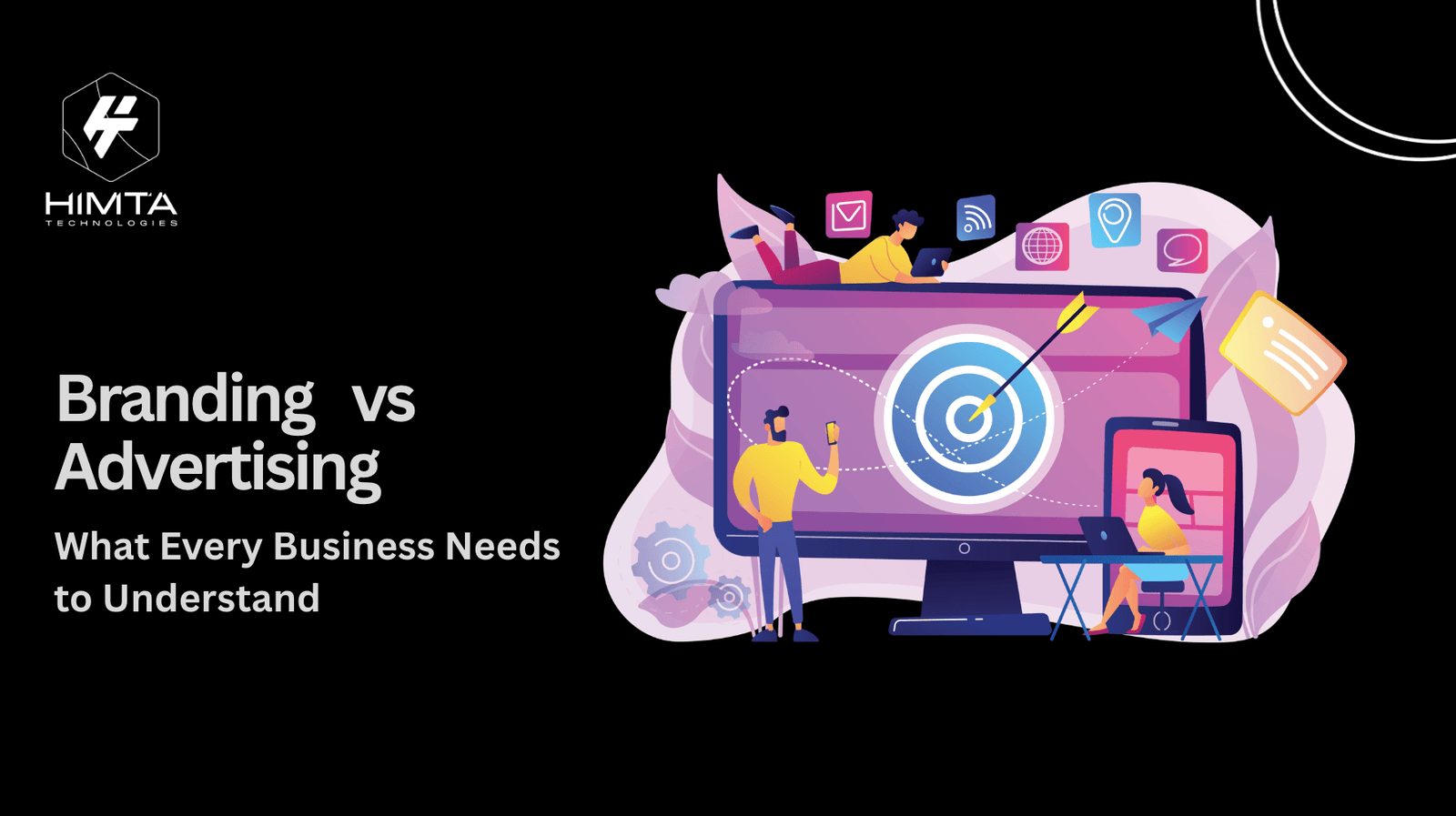
Most business owners use branding and advertising as if they mean the same thing. They don't. And that confusion — small as it may seem — quietly drains marketing budgets and slows down growth for companies across every industry.
If you're working with a creative branding company in Ahmedabad or investing in digital marketing services in Ahmedabad, knowing the real difference between these two disciplines isn't just academic. It shapes every decision you make, every rupee you spend, and every customer relationship you build.
What Is Branding, Really?
Branding is not your logo. It's not your color palette or your tagline. Those are expressions of your brand — they are not the brand itself.
Your brand is the gut feeling someone gets when they hear your company's name. It's built slowly, through repeated experiences, consistent communication, and the values your business genuinely lives by. No single campaign creates it. No single ad destroys it. It accumulates — for better or worse — over time.
A well-built brand answers one question that no advertisement can answer on your behalf: Why should someone trust us over everyone else?
That answer lives in your tone of communication, in the way your team handles a complaint, in whether your website experience matches the promise your sales team makes. It lives in your mission and whether customers can actually feel it — not just read it on an About page.
When businesses partner with a branding agency in Ahmedabad, the real work isn't selecting fonts or approving color swatches. It's positioning, differentiation, and storytelling that makes a business genuinely memorable in a market full of similar options.
What Is Advertising, and What Is It Actually For?
Advertising is action-oriented. It exists to get people to do something — visit your website, call your office, make a purchase, sign up for a demo. Where branding operates over years, advertising operates over weeks. It is campaign-driven, budget-dependent, and inherently short-to-medium term.
Advertising asks a completely different question than branding does: How do we get the right people to notice us right now?
It works through paid search and display campaigns, targeted social media promotions, retargeting sequences for warm audiences, and time-sensitive offers with direct calls to action. Businesses relying on digital marketing services in Ahmedabad use advertising to generate consistent lead flow — and it works. But there is a ceiling to what advertising alone can achieve, and that ceiling is determined entirely by the strength of the brand behind it.
Without brand foundation, advertising produces traffic that doesn't convert, leads that don't close, and customers who don't return.
The Real Differences Between Branding and Advertising
Purpose is where the distinction begins. Branding builds identity while advertising drives action. Branding shapes why people choose you. Advertising influences when they choose you. Both matter, but they operate at different depths.
Time horizon is the second major difference. A brand compounds. Every positive interaction, every consistent message, every satisfied customer adds to it. An ad campaign has a start date and an end date — when you stop paying, it stops working. Your brand doesn't stop working. That's an important asymmetry that most businesses underestimate when allocating budget.
The emotional versus transactional nature of each discipline is equally important to understand. People return to brands they feel something for — trust, familiarity, aspiration, belonging. People click on ads because of discounts, timing, or well-placed targeting. One builds loyalty. The other builds traffic. Both are valuable, but only one of them is irreplaceable.
Consistency versus flexibility further separates the two. Branding demands consistency — same values, same voice, same visual identity whether someone finds you through a Google search, a social media scroll, or a walk past your office. Advertising welcomes experimentation. You can change creatives, copy, offers, and audience targeting week to week without damaging anything. This is precisely why businesses that work with a creative branding company in Ahmedabad establish clear brand guidelines before they ever scale paid advertising — because without that foundation, flexible advertising creates fragmented perception.
Measurement works differently for each as well. Advertising metrics are direct and clean: cost per click, conversion rate, return on ad spend, cost per acquisition. Branding metrics are less direct but far more meaningful over time: brand recall, customer lifetime value, repeat purchase rate, net promoter score, and organic share of voice. They take longer to build — and longer to lose once established.
Why Businesses Confuse the Two — and Pay for It
The confusion is understandable. Advertising produces visible, trackable results quickly. Branding takes time and feels harder to justify on a quarterly balance sheet. So businesses default to advertising — they run more campaigns, test more creatives, increase budgets — and wonder why customer acquisition costs keep climbing while retention stays flat.
What's actually happening is straightforward: advertising without branding is like filling a leaking bucket. You can keep pouring more in, but the structural problem doesn't get addressed.
Three patterns consistently lead to this trap. The first is short-term pressure. When a business needs leads this month, branding feels like a luxury. But every month spent advertising without a brand foundation makes the following month's advertising more expensive, because nothing is being built that persists beyond the campaign.
The second pattern is starting backwards. Many businesses launch performance marketing before defining what they actually stand for. The result is inconsistent messaging that confuses potential customers rather than persuading them — even when the ads themselves are technically well-executed.
The third is platform blur. Social media can be used for branding and advertising simultaneously, which makes it genuinely difficult to plan without a clear strategy separating the two objectives. Without that clarity, businesses end up doing neither particularly well.
How Branding and Advertising Reinforce Each Other
These are not competing investments. They are complementary ones that multiply each other's effectiveness when aligned properly.
Think of branding as the structural foundation and advertising as the floors built above it. You cannot build higher without a solid base — but a foundation alone doesn't house anyone either.
When branding is strong, advertising performs measurably better. Ad creative resonates more because audiences already recognize the name. Click-through rates improve because trust is partially established before the ad is even seen. Conversion rates increase because the sales process has less friction to overcome. Customer acquisition costs fall over time as organic word-of-mouth grows alongside paid efforts.
This is the strategic value that agencies like Himta Technologies deliver — connecting brand strategy with performance campaigns so that businesses aren't forced to choose between short-term results and long-term equity. They build both simultaneously, with each reinforcing the other.
Branding in Competitive Markets
In any market where multiple businesses offer similar products at similar prices, brand becomes the deciding factor — and often the only differentiator that can't be easily copied.
A recognized, trusted brand can charge more without losing customers. It can weather a bad review or a slow quarter without lasting damage. It can launch new products into a market that already wants to hear from it. These are compounding advantages that simply cannot be purchased through advertising alone.
For businesses in Ahmedabad — a city with intensifying competition across manufacturing, professional services, retail, and technology — brand differentiation is increasingly the difference between a business that grows steadily on its own terms and one that competes permanently on price.
Advertising as a Growth Accelerator
When the brand foundation is in place, advertising becomes dramatically more effective as a growth tool. It gives businesses the ability to enter new markets and audience segments quickly, test product-market fit with real spending data, re-engage people who have already shown interest, and scale revenue efficiently during peak periods.
But advertising without brand foundation leads to high churn, weak loyalty, and constantly rising acquisition costs. Two identical ad campaigns — one running behind a strong brand and one behind a weak brand — will produce very different results. The creative, the targeting, and the budget can be identical. The outcomes won't be.
Knowing When to Prioritize Each
For early-stage businesses, the priority should be brand foundation first. Before scaling paid campaigns, define your positioning, your voice, your visual identity, and your core message. Advertising spend without this in place tends to produce inconsistent and often disappointing results, because there is nothing for the audience to connect with beyond the immediate offer.
Growth-stage businesses need both working in parallel. Brand work ensures the business isn't becoming a commodity as it scales. Advertising ensures enough of the right people are being reached to sustain that growth. Neither can be neglected at this stage without consequences.
Established businesses should focus advertising increasingly on retention and loyalty rather than pure acquisition, while continuously reinforcing the brand positioning that earned their market share in the first place. The goal shifts from reaching new customers to deepening relationships with existing ones — and branding is the primary vehicle for that.
Mistakes That Undermine Both
Inconsistent messaging across campaigns is one of the most damaging and most common errors. Running different brand voices or visual styles across channels creates confusion that erodes trust even when individual ads perform well in isolation. Customers notice the inconsistency, even if they can't articulate it.
Over-reliance on paid channels is another structural risk. Businesses that live and die by advertising performance have no buffer when platforms change algorithms, raise prices, or restrict targeting options — all of which happen regularly. Brand equity is that buffer. It's the asset that continues generating value when paid campaigns pause.
Underinvesting in customer experience quietly undermines everything else. Every interaction a customer has with your business contributes to brand perception — the ease of your checkout process, the speed of your customer support, the follow-up email after a purchase. Strong visual branding and effective ad copy cannot compensate for a frustrating experience on the other side of the sale.
Building a Strategy That Lasts
A sustainable marketing strategy treats branding and advertising not as separate line items competing for the same budget, but as two parts of a single integrated system.
That means establishing clear brand positioning before scaling ad spend, maintaining visual and tonal consistency across every platform and customer touchpoint, using advertising to amplify brand messages rather than contradict them, and tracking both performance metrics and perception metrics over time. Neither set of numbers tells the whole story alone.
When these elements are aligned, the result is compounding growth — each advertising campaign benefits from accumulated brand trust, and each brand-building effort makes future advertising more efficient and more effective. Over time, the two become impossible to separate, because the brand is present in every campaign and every campaign reinforces the brand.
The Conclusion
Advertising captures attention. Branding earns loyalty. Both are necessary, but they are not interchangeable — and treating them as if they are is one of the most expensive mistakes a growing business can make.
Businesses that treat advertising as a shortcut to what only branding can build will always find themselves spending more for diminishing returns. Businesses that invest in brand foundation first — and then use advertising to amplify it — build something that competitors find genuinely difficult to replicate, regardless of how much they spend.
For businesses in Ahmedabad looking to grow with intention and consistency, working with a branding agency in Ahmedabad alongside performance-driven digital marketing services in Ahmedabad is not a choice between two strategies. It's the recognition that sustainable growth comes from both working together — strategically aligned, consistently executed, and built to last beyond the next campaign cycle.